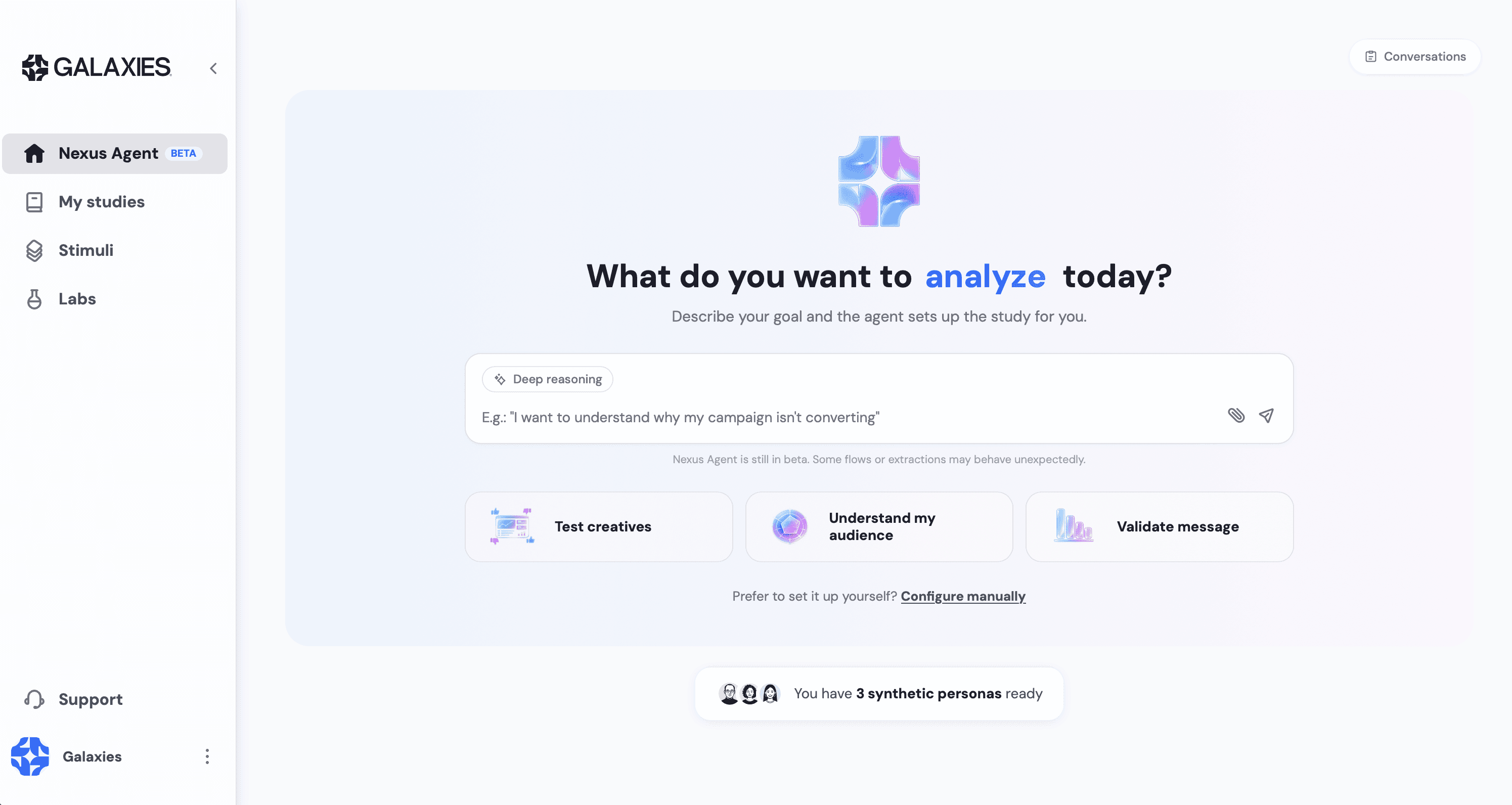

Start with a question. Explore it with Nexus.
Tell Nexus what you want to understand, test, or explore. Use it to build studies, analyze ideas, or have a conversation with a synthetic persona.
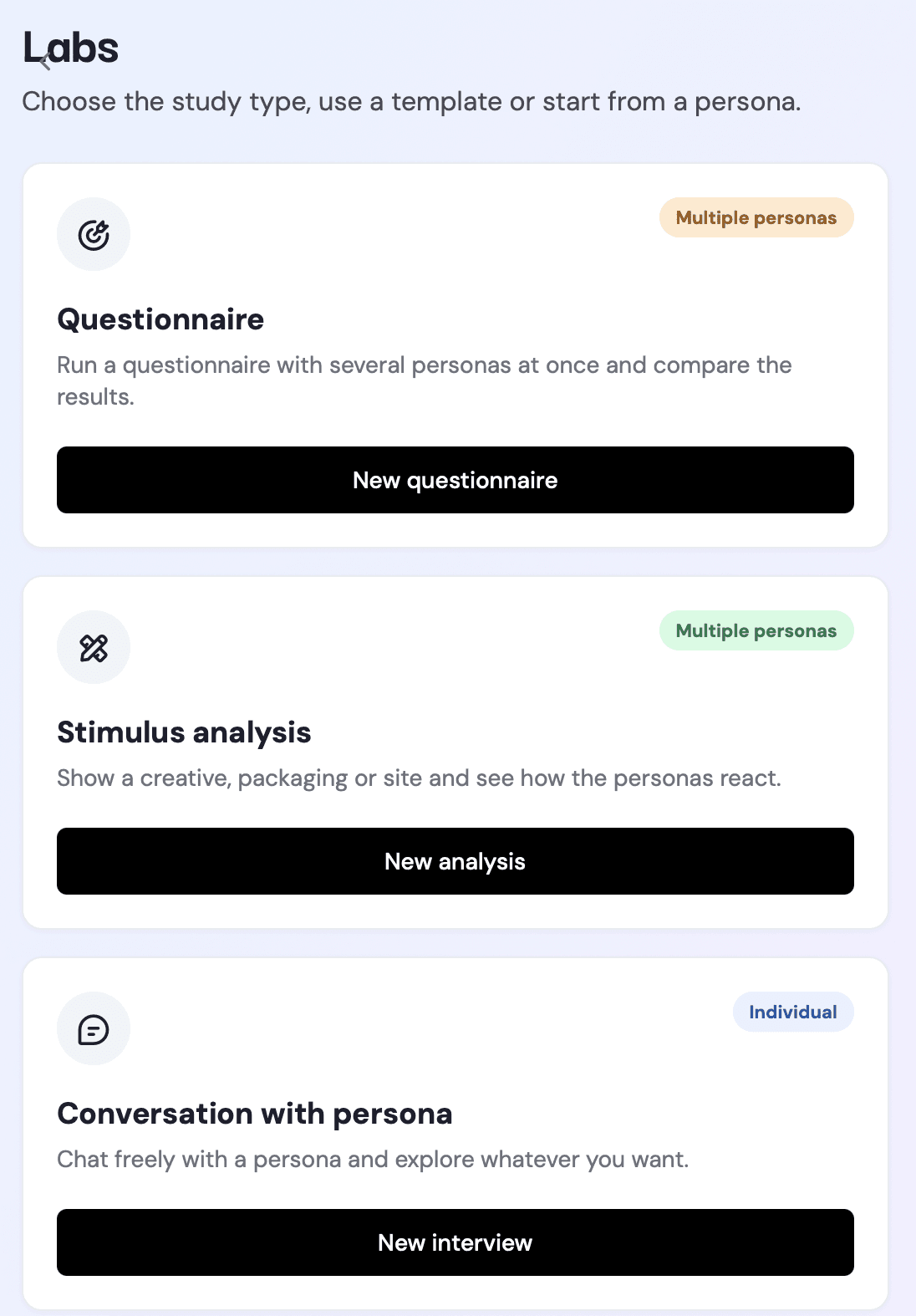
Questionnaire
Build and run structured questionnaires to explore consumer opinions at scale.
Stimulus analysis
Test a concept, ad, product, or other stimulus and compare how consumers respond.
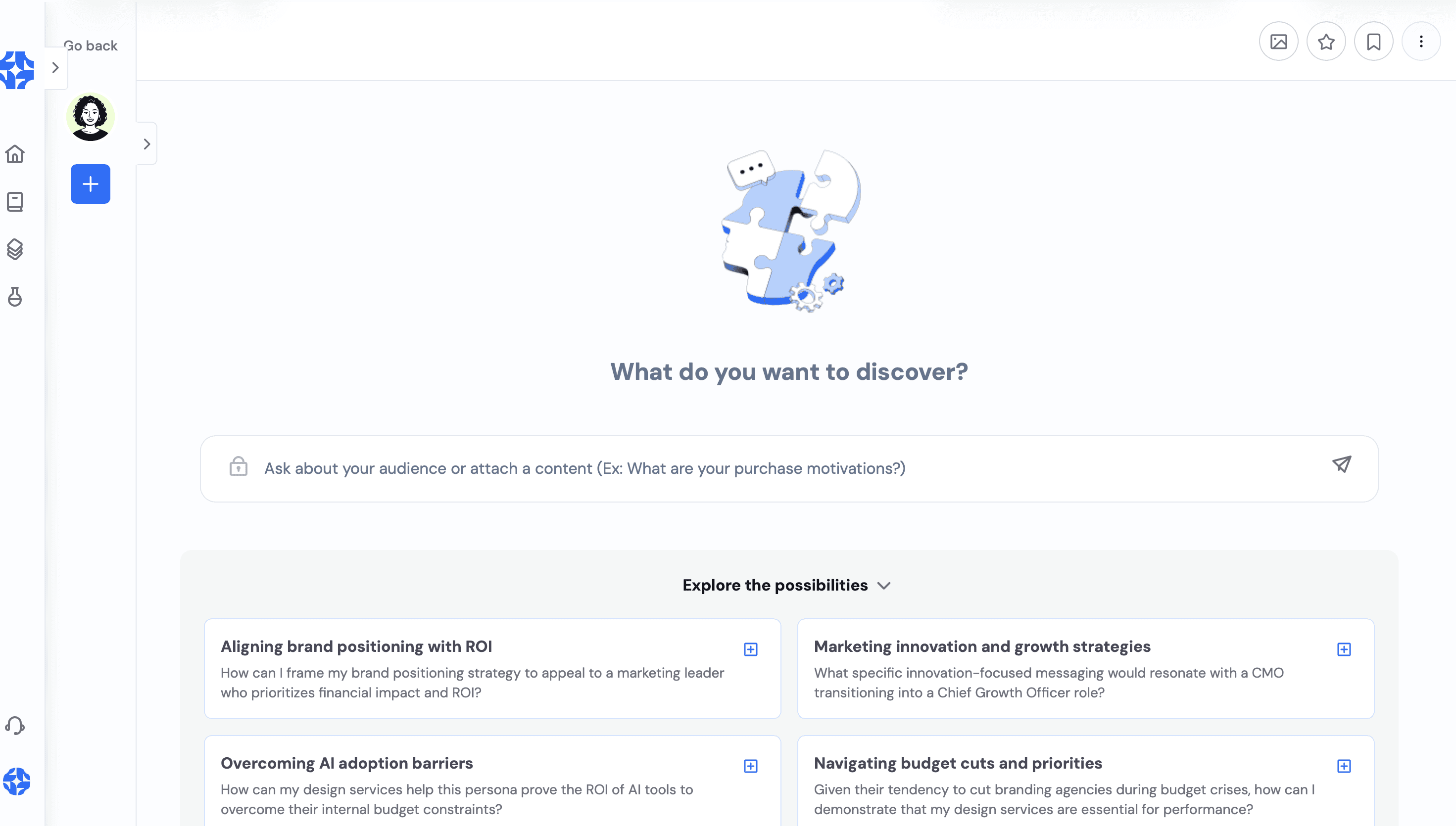
Conversation with persona
Talk to a synthetic persona grounded in real consumer data to explore motivations and perspectives.
BENEFITS
Go from question to insight, faster.
Minutes, not weeks
Explore questions, test ideas, and learn from consumers faster.
Built for Marketing
From campaign concepts to product ideas, explore the questions behind your next move.
Grounded in real consumer data
Synthetic personas built from data collected from real consumers.
Three ways to explore, one agent
Questionnaires, stimulus analysis, and persona conversations, with Nexus Agent to guide you.
Explore before you commit
Get early feedback on ideas before investing time and resources.
Go beyond the results
Dive deeper into individual responses by talking to the personas behind them.
Ask at scale.
Get structured feedback from synthetic personas with questionnaires built around what you want to understand.


See how synthetic personas react. Then explore why.
Put a concept, ad, or product in front of consumers and compare their responses to rank the best for your goal.
New
Latest insights

AI Audience Segmentation: How to Find the Profiles That Actually Move Your Campaign
AI Audience Segmentation: How to Find the Profiles That Actually Move Your Campaign
Segmenting audience with AI means finding, inside a brand's full audience, the profile clusters that react differently to messages, creative, and offers, instead of treating the audience as one block. In Nexus, Galaxies documented a user acquisition and creative A/B test case where identifying strategic audience segments cut new user acquisition cost by 52% and made creative improvements 70% faster.
The Cost of Segmenting on the Surface
Shallow segmentation is one of the most common ways to waste media budget. A campaign built for an “average” audience usually doesn't speak deeply to anyone. It misses the chance to use the right language, trigger, and argument for the profiles most likely to convert.
The problem is rarely a lack of demographic data. Most companies already know their audience's age, region, and income. The problem is the missing behavioral layer: understanding why different profiles react differently to the same message, not just who they are on paper. That layer sits at the center of a [Marketing Decision Engine].
The Case: Segmentation Guiding Creative in Nexus
In the case Galaxies published, the goal was to cut new user acquisition cost through a deeper understanding of the audience. The team used Nexus to identify strategic profile segments, then used those segments to guide creative production and optimization, testing scripts, hooks, and formats against simulated audience clusters before real production. For the operating layer behind this process, see [What Is the Nexus Platform].
The documented result: a 52% cut in new user acquisition cost and a 70% gain in creative improvement speed. Direct evidence that segmenting by behavioral depth, not just demographics, changes a campaign's outcome. The same reasoning applies to decisions like [Campaign Pre-Testing and Brand Lift].
How to Structure Behavioral Segmentation in Nexus
1. Go beyond demographic data. Age, region, and income describe who the audience is. Motivation, objection, and decision trigger describe why they act.
2. Test reaction by cluster, not by overall average. An average reaction across the whole audience hides both the profiles most likely to convert and the ones who reject the message.
3. Identify the right trigger for each segment. Scarcity, social proof, urgency, and other communication triggers work differently depending on the profile.
4. Direct creative and media by priority segment. Once the highest-potential clusters are identified, production and media investment can go to them first.
When segmentation informs creative this way, the team stops testing generic pieces and starts testing specific arguments for specific profiles. It's the same logic behind [How to Validate Campaign Creative With AI Before It Airs], applied from the moment clusters are defined.
Frequently Asked Questions
Which audience segments actually convert in my campaign?
The segments that react differently to message, creative, and decision trigger. Found by testing reaction per behavioral cluster in Nexus, not by an overall audience average.
How do you segment audience with AI?
By finding audience clusters that react differently to messages and creative, based on behavior and motivation rather than demographics alone, then directing creative and media to the segments with the highest conversion potential.
What's the difference between demographic and behavioral segmentation?
Demographic segmentation describes who the audience is: age, region, income. Behavioral segmentation finds why different profiles react differently to the same message, based on motivation, objection, and decision trigger.
Speak Deeply to the People Who Matter
A campaign that tries to speak to everyone ends up not speaking deeply to anyone. Segmenting by behavioral depth, not just demographics, is what separates a campaign that reaches an audience from one that actually converts. The same care strengthens decisions like [Synthetic Personas for Validating Product Positioning] before scaling.
Find the segments in your market.
Rafael Tortella

Synthetic Personas for Validating Product Positioning: How to Test Message and Value Proposition
Synthetic Personas for Validating Product Positioning: How to Test Message and Value Proposition
Validating product positioning means testing whether the message and value proposition a company plans to communicate actually make sense to its target audience, before launching campaigns or training the sales team around it. In Nexus, Galaxies' synthetic persona platform, this test happens in minutes, comparing message versions before choosing which one goes to market.
The Gap Between What the Company Says and What the Customer Hears
Every company has a positioning message approved internally: tested in a meeting, validated by team consensus. The problem is that internal approval and external resonance are different things. A message can make complete sense to someone who already understands the product from the inside, and still communicate nothing relevant to someone on the other side, deciding whether it solves a problem they have.
This gap rarely shows up before launch, because message approval usually stops at internal validation, without a real test against the audience that will actually receive the communication. That's why positioning needs to leave internal opinion behind and enter a [Marketing Decision Engine].
How to Test Positioning With Synthetic Personas
1. Write more than one version of the message. Testing a single version only confirms or disproves one hypothesis. Comparing variations reveals which value proposition resonates more. For the foundation behind this simulated audience, see [The Complete Guide to Synthetic Personas].
2. Show each version to the simulated target audience in Nexus. The message should appear without the company's internal context, exactly as a real customer would see it for the first time. This flow runs inside the [Nexus Platform].
3. Measure comprehension, not just preference. Ask what the message communicates, not just whether it's likeable. A message can sound good and still communicate the wrong thing.
4. Identify objections by profile. Different audience segments can hesitate for different reasons in front of the same value proposition.
5. Refine before you scale. Adjust the message based on what the test revealed, before training the sales team or investing in a campaign built around it.
Signs Your Positioning Needs Work
Three recurring signs show a positioning message isn't ready to scale: the audience can't repeat, in their own words, what the product does; the value proposition sounds generic enough to apply to any competitor; or the reaction is neutral, neither rejection nor enthusiasm, which usually means the message never touched a real pain point.
Any of these signs is cheaper to find in a test than in an entire campaign built around the wrong message. Once positioning is more mature, the next step can be [How to Validate Campaign Creative With AI Before It Airs].
Frequently Asked Questions
How do I know if my positioning message communicates value to the customer?
Test different versions of the message with the real target audience in Nexus and measure comprehension: whether the audience can repeat, in their own words, what the product does, instead of only measuring whether the message is likeable.
How do you validate a product's positioning?
By testing different versions of the message and value proposition with the real target audience, measuring comprehension and profile-specific objections, before scaling the message into a campaign or sales training.
What's the difference between testing positioning and testing a full campaign?
Positioning tests the core message and value proposition itself, the foundation specific campaigns get built on afterward. Testing a campaign evaluates the creative execution of that message in a specific context.
How long does it take to test positioning with synthetic personas?
Comparing multiple message versions and getting structured reactions can happen in minutes, with your own business's audience, whenever you need it.
The Message That Survives Contact With the Customer
A value proposition is only good once it survives contact with someone who doesn't know the company from the inside. Testing that before scaling is the difference between finding a messaging problem in a few minutes' conversation or in an entire campaign that didn't convert the way it should have. Before approving the final message, it's worth reviewing [7 Questions Every CMO Should Answer Before Approving a Launch] too.
Test your value proposition with the right audience.
Carol Yoshida

Brand Lift and Campaign Pre-Testing: How to Measure a Campaign's Impact Before and After It Airs
Brand Lift and Campaign Pre-Testing: How to Measure a Campaign's Impact Before and After It Airs
Brand lift measures how much a campaign shifts a brand's perception, recall, or purchase intent, comparing audience reaction before and after exposure. In Nexus, Galaxies' synthetic persona platform, that comparison happens before a single impression is bought: the campaign runs against a simulated audience first, so the team knows what to expect before deciding whether it's worth the media spend.
The Pain of Proving Brand Impact
Most brand lift studies happen after the campaign has already run, once the media budget is spent and the only thing left to measure is whether it worked. By then, a weak lift number doesn't buy back the spend, it just explains why the quarter's results came in soft.
The fix isn't measuring harder after the fact, it's testing before the campaign exists in the world. That's the same principle behind [How to Validate Campaign Creative With AI Before It Airs], applied one layer up: not just the creative, but the brand outcome it's supposed to produce.
Predicted Lift vs. Measured Lift
A pre-test doesn't replace measurement, it gives the team something to measure against. Running the campaign against a simulated audience in Nexus produces a predicted lift before launch: expected movement in awareness, recall, or intent, broken down by segment.
Comparing that prediction to the real, post-launch lift is what turns brand measurement into a feedback loop instead of a one-time report card. The mechanics behind that simulated audience live in [What Is the Nexus Platform].
How to Structure a Brand Lift Pre-Test in Nexus
1. Define the lift metric before testing. Awareness, message recall, and purchase intent move differently, decide which one the campaign is actually meant to shift.
2. Run the campaign against a simulated audience before media spend. Nexus exposes the creative to synthetic personas built from the target audience and measures the shift in the chosen metric.
3. Segment predicted lift by audience profile. A campaign can lift intent strongly in one segment and barely move another, an overall average hides that difference.
4. Set a go/no-go threshold before seeing the result. Decide what predicted lift justifies the spend before the number exists, not after.
Once the threshold is set, the same simulated audience that produced the prediction becomes the basis for comparison against real results after launch. That comparison is what separates a guess about a campaign's impact from a decision inside a real [Marketing Decision Engine].
Frequently Asked Questions
What is brand lift and how is it measured?
Brand lift is the change in a brand's awareness, message recall, or purchase intent caused by a campaign, measured by comparing audience response before and after exposure. Testing that shift against a simulated audience before launch produces a predicted lift to compare against the real result later.
Can you measure brand lift before a campaign airs?
Yes. Running the campaign against a simulated target audience in Nexus produces a predicted lift score before any media is bought, segmented by audience profile, so the team can set a spend threshold ahead of time instead of finding out after the budget is gone.
What's the difference between predicted lift and measured lift?
Predicted lift comes from testing the campaign against a simulated audience before launch. Measured lift comes from real audience response after the campaign runs. Comparing the two shows whether the pre-test assumptions held, and sharpens the next prediction.
Predict Before You Prove
Brand lift only proves a campaign worked once it's already run, and already spent. A predicted lift number, tested against a simulated audience before launch, is what turns that proof into a decision made in advance instead of a result read afterward. Before approving the final campaign, it's worth reviewing [7 Questions Every CMO Should Answer Before Approving a Launch] too.
See your campaign's impact before it goes live.
Pietro Lancieri
Stop guessing what your consumer thinks.
Bring us a decision you're stuck on, and we'll show you how fast it moves.
FAQ
Answers to common questions
What marketing teams ask before running their first study with Galaxies.
What is Nexus?
How is this different from a traditional research agency?
What does "minutes, not weeks" actually mean?
Are the consumers real?
Still have questions? Contact support.