
About Nexus
We didn't set out to build a research tool. We set out to stop money moving before anyone knew if it was right.
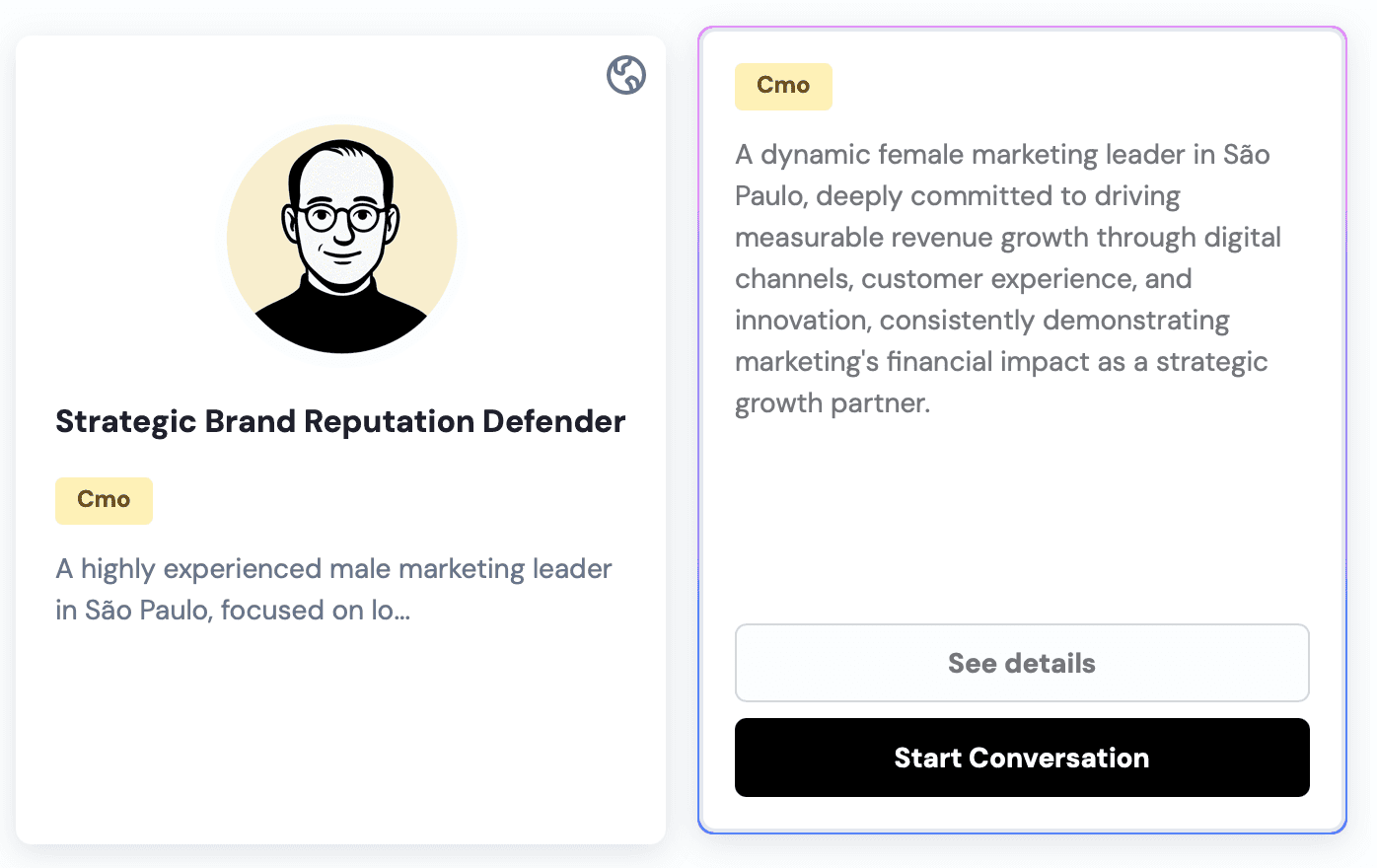
Nexus helps Marketing teams bring consumer perspectives into the moments that matter — from testing ideas and creatives to exploring audiences with synthetic personas grounded in real consumer data.
Three moments changed what we were building — each one forced by data that contradicted what we believed.
The persona stopped being the product. It became an ingredient.
The product became the decision itself: a recommendation with a source, a confidence level, a stated caveat, and human review — something you can actually defend in a room, not just a simulated opinion.
The buyer got sharper.
Clients are far better informed now, and clear-eyed about what synthetic simulation is actually for: not a replacement for judgment, but a way to do the same work with more context, more precision, and far more speed.
The real barrier wasn't the persona. It was memory.
Data that just sits there is an archive. What creates value is the cycle: a decision becomes an action, the action produces a result, the result recalibrates the next decision — and none of it is lost. It stays with the account.
Marketing moves fast. Consumer understanding should keep up.
Marketing teams constantly need to evaluate new ideas: from campaigns and creatives to products and experiences. But getting consumer input can still mean waiting for a research project to be planned, run, and analyzed.
Nexus gives teams a faster way to bring consumer perspectives into their work, whenever they need them.


Why now
AI has made it possible to create and interact with synthetic audiences at a scale that wasn't practical before. At the same time, marketing cycles have become shorter, creating a need for faster ways to get consumer input.
Nexus was built at that intersection: combining real consumer data with AI to make consumer exploration more accessible to Marketing teams.
Galaxies tests ideas against real consumer behavior, not assumptions.
Every simulation runs on real data, not a guess. That's how brands decide in days what used to take months to validate. Nexus runs on that exact same engine.


Real audiences, not assumptions.
Nexus isn't a chatbot wearing a persona. It's built on a three-part architecture:
Data ingestion
Real consumer data, sourced from the client, forms the foundation. Nexus doesn't simulate a market it hasn't seen.
Brain creation
That data is used to fine-tune the models behind each audience, so responses reflect how people actually think and decide, not how a general-purpose model guesses they might.
The five senses
the finished audience is deployed through agents that can be questioned, shown stimuli, and put in conversation, the same way a real research panel would be.
The result: a synthetic audience that behaves like the one it's modeled on, available on demand instead of on a six-week timeline.

Becoming part of how the decision gets made.
Today, Nexus helps teams bring consumer perspectives into their work. Over time, we're building toward something bigger: a layer of intelligence that connects consumer understanding, marketing actions, and what happens next.
The goal is to make consumer intelligence more continuous, contextual, and useful, helping teams learn from every decision and carry that learning into the next one.
Ask your first question.
See what Nexus tells you before you brief an agency.